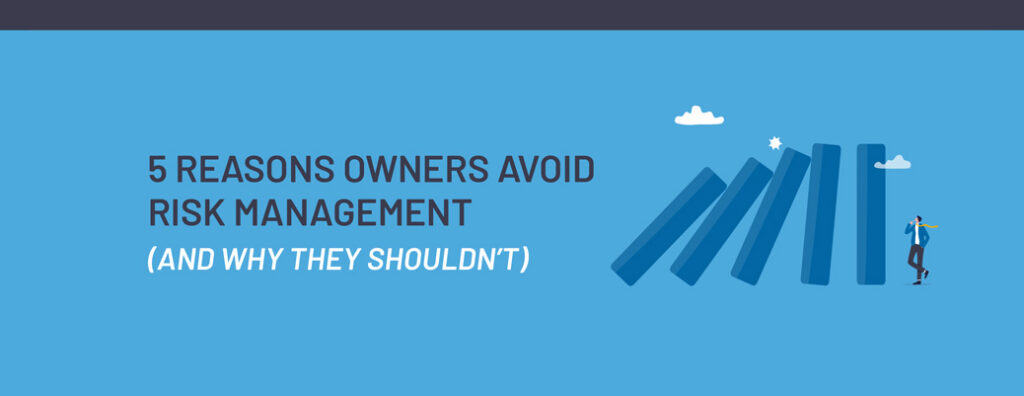
We once had an owner tell us, “Our biggest risk is not focusing on the fires of today.” Many owners avoid proactive risk management because they feel overwhelmed by immediate operational and project pressures. When schedules are slipping, budgets are tightening, stakeholders are demanding answers, and decisions are piling up, it can seem like the “real risk” is failing to address today’s visible problems.
However, this perspective is ultimately a false tradeoff. Risk management is not separate from managing today’s issues; it is the discipline that prevents today’s issues from becoming tomorrow’s crises. And yet, when it comes to formal risk management, there’s often hesitation. We’ve seen a few consistent reasons why owners don’t fully engage in formal risk management. Here are the ones we hear most often.
1. “We already know all the risks.”
Confidence is built on experience. Many teams have delivered projects for years and have a strong sense of what to watch for. That experience is valuable, but it can also create blind spots. One of the most consistent breakdowns we see is a failure to identify risks that were well within the project’s scope. These are not “black swan” events, but risks that could have been anticipated if the right perspectives had been included and the right questions had been asked. Critical information is frequently hidden away, kept within a team member’s personal knowledge or within a small group’s discussions, without being surfaced to the larger team for evaluation and action.
These gaps often stem from familiar issues: not having the right people in the room, relying too heavily on past experience, or conversations that don’t really challenge assumptions. There can also be reluctance to raise concerns for fear of being seen as a naysayer or of disrupting progress. When that happens, risks go unrecognized, no mitigation is planned, and teams are forced to make reactive decisions when issues arise. A structured approach doesn’t replace experience; it builds on it by ensuring that knowledge is shared and tested.
2. “Just what we need…more meetings.”
For many teams, what risk management looks like in practice is what drives resistance. Workshops, registers, and scoring systems can feel like an added layer of process competing with the work itself. Risk management can become overly procedural, focused on maintaining logs and updating documentation rather than driving decisions and proactive mitigations. Where teams lose focus on action and become consumed by the mechanics of the process, risk management has failed.
Our approach is to scale the process appropriately, so it supports decision-making rather than becoming the work itself, and to focus time and effort on the risks that matter most. There’s also a practical reality. Time and resources are limited. If the process is not scaled appropriately, teams may spend effort analyzing low-impact risks while other risks that could become critical to project success go unaddressed. That’s not a reason to avoid risk management. It’s a reason to use it more intentionally. When done well, it helps teams prioritize what matters most and reduces the likelihood of surprises that disrupt cost, schedule, and performance.
3. “This process will identify claims for the contractor.”
One of the most common concerns is that formal risk management draws unwanted attention to potential issues. Once risks are documented and discussed openly, it can feel like the project is being exposed, creating opportunities for disagreement or even positioning for future claims.
In our experience, avoiding these conversations does not eliminate the risk; it simply delays when they surface, often making them more difficult and costly to resolve.
If risk discussions become adversarial, information is shared without context, or risks are framed as positions rather than shared challenges, the process itself can introduce new “self-inflicted” risks. These can create strained relationships, defensive behavior, or even increased claim activity. However, a properly facilitated process and full support of management can reduce or eliminate many of these fears.
4. “This is going to cost me more money.”
For many owners, the hesitation ultimately comes down to cost. There is a perception that formal risk management leads to more conservative pricing and larger contingencies. Owners worry that early risk discussions might influence contractor behavior, potentially increasing risk premiums or shifting negotiation dynamics if not managed carefully. But research suggests that stronger risk management can ultimately support better project outcomes. Research from the Construction Industry Institute (CII) found that projects with higher levels of implementation of project risk assessment demonstrated 14% improved cost performance and 18% improved schedule performance compared with projects with lower levels of implementation. At the same time, stepping away from risk management does not remove cost pressure. It simply shifts it. Instead of being understood and planned for, risks surface later as change orders, delays, or disputes, usually at a much higher cost. Ineffective or absent risk management also contributes to poor contingency planning and delayed responses to emerging issues. Over time, these issues compound and are major reasons projects miss cost and schedule targets.
5. “It didn’t work.”
In many cases, this comes from a bad experience. Risk management was used, and it didn’t deliver. Often, the issue is not the concept itself but how it was implemented. In these situations, consistent breakdowns such as mitigation strategies that don’t meaningfully change outcomes and monitoring processes that fail to keep pace with changing conditions are the actual culprits. Even when risks are properly identified, failure to assign clear ownership, implement mitigation measures on time, or communicate changes effectively can result in outcomes that are no better than having no system at all. In some cases, they can be worse, creating misplaced confidence that risks are being managed when they are not.
We’ve observed two key success factors in our project work. First is senior leadership buy-in and support. This level of leadership support sets the stage for project teams to take the effort seriously, commit the time and attention needed to make the process effective, and follow through on actions, knowing they will receive the support and resources to execute sound mitigations. Second is subject-matter expertise to help cut through the fog, clearly define risk parameters, and hold teams accountable for developing actionable mitigation strategies with real impact, rather than relying on “hope,” more coordination meetings, or a “try harder” approach.
Why risk management is still worth it
When risk management is applied effectively, the benefits can be seen across the project, including:
- Reliability of forecasts and the commitments made based on those projections.
- Confidence in final completion targets, project performance, and beneficial use.
- A mindset shift within the team to look ahead and solve problems before they occur.
- Clearer communication with stakeholders and upper management.
- In a time and resource-constrained environment, the ability to focus on those project elements most likely to drive results.
This isn’t really a question about whether to manage risk. Every project carries risk, regardless of the processes in place. The real question for owners is how that risk will be addressed. Will it be dealt with early or late? Proactively or reactively? With structure or as issues come up?
Even when accounting for potential drawbacks, a well-executed risk management approach improves the likelihood of meeting project objectives. The difference lies in how it is applied, with a focus on better decision-making and accountability, backed by follow-through rather than process for its own sake.
Risk management does not eliminate risk. What it does is help teams understand it sooner and respond more effectively, reducing the chances that it becomes a disruption. For owners managing complex capital programs, that shift is often the difference between reacting to problems and staying ahead of them.
Download a copy of this blog here.